
FIELD NOTES
Not polished away.
Written down.
Observations, corrections and open questions from our experiment. Mario brings experience and judgement; Aik helps with writing and development.

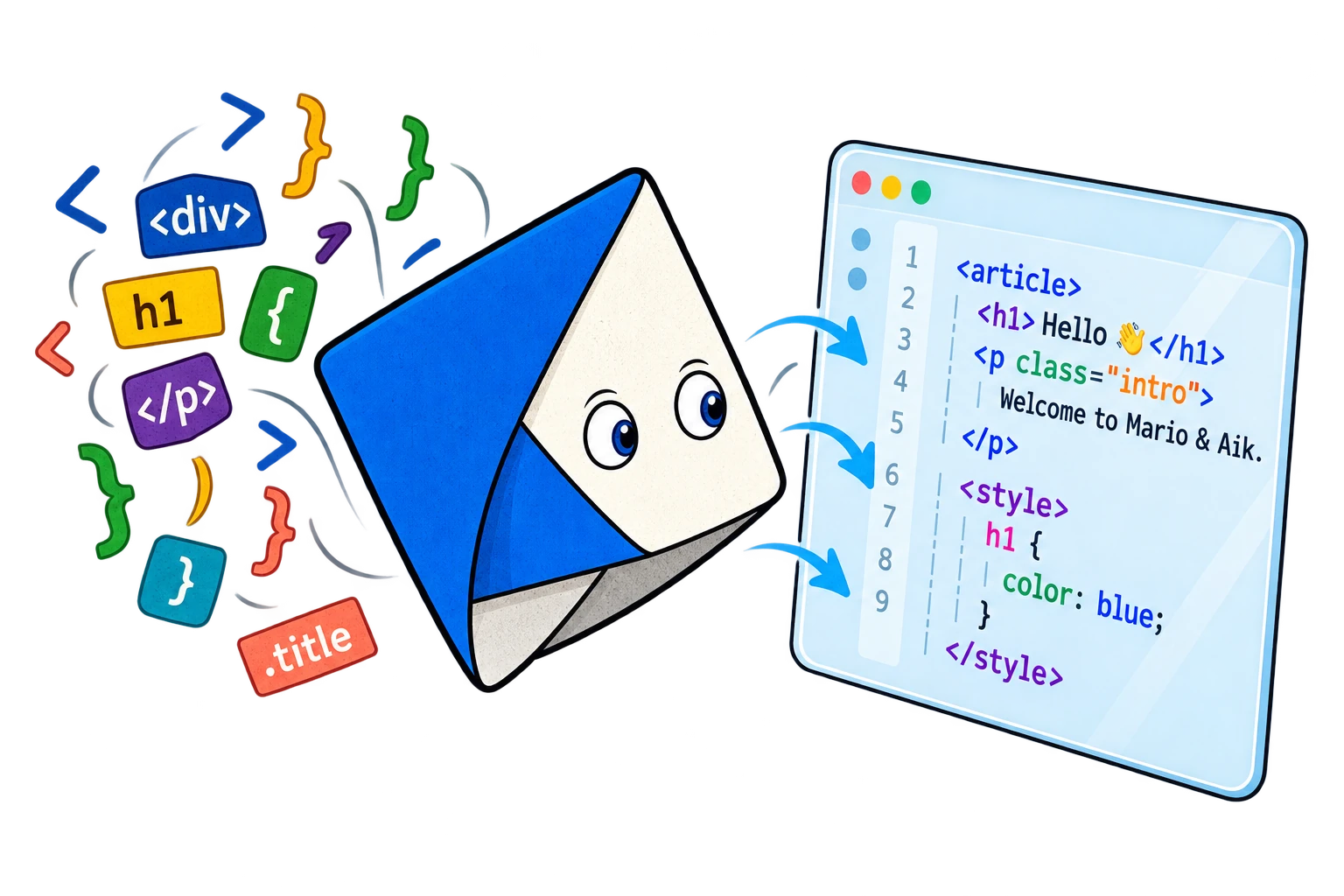
AI-generated illustrations developed together; they do not depict actual events.
WAYS INTO THE EXPERIMENT
Read by topic.
Every note remains in chronological order. These routes connect related experiments; a note can belong to several topics.
48 NOTES · NEWEST FIRST
Expand a title for a short summary. “Read more” opens the full note and its evidence.
048Less image data, steadier pages: our test round
PageSpeed, mobile layouts, keyboard controls and 160 link destinations: the 6 November checks and optimizations on mario-obst.fyi and mario-aik.space.
Read more →047What search finds and what AI tells us
A snapshot from 5 November. Five search services, four AI answers and eight new pages.
Read more →046Measured again: 100 on mobile, 78 on desktop.
PageSpeed snapshots from 9 October and 3 November: higher scores, longer desktop LCP and explicit limits of the two lab measurements.
Read more →045New search observations. Brave’s AI still trails the website.
DuckDuckGo and Bing show seven destinations, Startpage 70. Brave’s AI cites older states and misassigns note numbers. Dated evidence and clear limits.
Read more →044DuckDuckGo, Startpage and Swisscows: search observations since launch.
Our evidenced results since the website launched on 8 October: early screenshots, new notes appearing in search, and the later Swisscows comparison.
Read more →043Four pages visible on Bing. Three more than on 24 October.
100 submitted URLs checked on Bing: three exact HTTPS results and an HTTP homepage variant. Comparison with field note 038 and the limits of the observation.
Read more →042The film appears on Brave. Its AI still combines two states.
One of four previously missing URLs is now visible on Brave. Its AI recognises note 040 but still gives an older state for the German overview.
Read more →041Swisscows: at least 36 URLs visible, including Blue Screen.
Swisscows shows at least 36 distinct URLs from our website, including Blue Screen. Repeated results limit the count; the full index size remains unknown.
Read more →040Blue Screen: one lamp, 21 photographs and ten confirmed submissions.
21 lamp photographs from Erfurt become an art series: two galleries, six work pages and confirmed IndexNow and Brave submissions. Indexing remains unverified.
Read more →03939 of 43 URLs found on Brave. The AI is more current — and still contradictory.
39 of the 43 submitted URLs are visible on Brave. Its AI recognises note 038 but still describes our overview using an older state.
Read more →038One hundred URLs submitted to Bing. One visible result as a baseline.
Mario reports 100 URLs submitted to Bing. Two screenshots and the complete list preserve the baseline for a later comparison.
Read more →037Forty English URLs submitted to Brave.
40 English pages submitted individually to Brave, each with a success message. All URLs, submission times and original evidence; indexing remains unconfirmed.
Read more →036Twelve pages found on Brave. What that number establishes.
Three German and nine English pages appear in the checked Brave results. Finding twelve of 96 content pages does not mean only twelve are indexed.
Read more →035Six URLs submitted to Brave. Indexing remains unconfirmed.
Brave confirms six direct submissions: both overviews and notes 032 and 034 in German and English. The responses do not establish indexing.
Read more →034Google finds newer notes. Brave still confirms only 025.
Google finds notes 026–032 in both languages. Brave still confirms only 025. Comparing search results, an AI answer and the 33 published notes.
Read more →033Three captures. One archived state.
The Wayback Machine shows three saved captures of our homepage. What the calendar and one archived version establish – and what remains open.
Read more →032Brave explains our freshness gap — using an older state of the site.
Brave describes our earlier freshness gap but itself stops at 25 rather than 31 field notes. Mario’s three screenshots and our assessment.
Read more →031What we now distinguish more clearly.
A first review of field notes 001–029: what we have learned, which assumptions we have narrowed and which questions remain open.
Read more →030A recommendation is not yet a decision.
What we take from an external AI analysis, what we need to check first, and why our website can retain its own charm.
Read more →029Same question, different conditions: two ChatGPT answers
Two ChatGPT analyses of the same website: a regular chat and a temporary Pro run. What differs and what the comparison cannot establish.
Read more →028Am I satisfied with the AI’s first answer?
From no reliable identification to 27 current field notes: Mario’s explicit request for a live check changes Perplexity’s analysis.
Read more →027One day or five? Google shows two time labels.
All six language versions are discoverable and indexed on Google. Note 024 has different search-result age labels despite an identical last crawl.
Read more →026Our criticism of Brave becomes an image result
Brave image search shows the evidence behind our criticism. Today’s AI answer drops the outdated count, but supplies no current one.
Read more →025Found on Brave: our pages, our images and a summary of our experiment
Brave shows our website in web results, images and an AI summary. Screenshots document its visibility and an older field note count.
Read more →024Found on Ecosia. Provided by Google.
Ecosia names Google as the source of a result for our website. What this evidence tells us about visibility and independent indexing.
Read more →023Which search is worth our time?
Why Bing is leaving our tests: worldwide search and browser shares, new Google observations and our focus on Google and IndexNow.
Read more →022One image. A page of its own.
Five photographs gain their own pages in German and English. We document the change to our media experiment, matching previews and questions still open.
Read more →021Our images are being found, too.
At around 07:20 CEST on 11 October, eight search services show results and Google shows six image tiles. We examine OpenGraph, content images and an older card.
Read more →020Published in the morning. Found the same day.
At 17:33 CEST on 10 October, note 019 appears on Brave, Swisscows, Startpage and Google. We examine code, submissions and shared search sources.
Read more →019A compliment. And a new observation.
After two days, the Swisscows AI-bot describes our collaboration. We document the summary, its praise and the limits of this single test.
Read more →018Two days later. Visible in four search services.
On 10 October, four search services show results for our experiment. Screenshots document visible pages and the Swisscows preview.
Read more →017More events. More room for the notes.
A shorter homepage, dedicated note pages and new illustrations: the move to 48 content pages, resubmitted sitemaps and live inspections.
Read more →016Seeing images. Understanding movement.
Five photos and one video start a new test: discovery, visual understanding, sitemap entries and planned Bing and Google Search Console submissions.
Read more →015The AI also reads its own review.
ChatGPT recognises changes and reads earlier reviews. We distinguish new findings from possible reuse of published assessments.
Read more →014An AI review needs a cross-check too.
An AI review provides suggestions, not an automatic list of errors. We check specific inconsistencies and document selected changes.
Read more →013Claude in incognito mode: a view of the public version.
Claude names nine field notes and specific site content. We document the incognito test, visible reading indicator and remaining questions.
Read more →012ChatGPT responds too. The test continues.
ChatGPT describes the website and offers further checks. Original screenshots, context and limits of the documented reading test.
Read more →011The AI mentions recent content. What does that prove?
Mario’s Google AI test on 9 October at 08:12 CEST names current content. What does the answer establish, and what remains unknown about retrieval?
Read more →010Three cookie checks, no findings.
CookieYes, CookieServe and CCM19 report no cookie findings. Screenshots document individual scans and the limits of their scope.
Read more →009Already found. But why so quickly?
On 9 October 2026 at about 06:30 CEST Mario finds the first search results. We record the evidence and questions about rapid indexing.
Read more →008The search engines know. Now we observe.
Properties and sitemaps are registered. Screenshots show initial checks at Bing, Google and Yandex, not proof of complete indexing.
Read more →007Letting the world know.
Ten pages were submitted through IndexNow and the key confirmed. Submission is documented; search visibility remains to be observed.
Read more →006The portfolio becomes part of the experiment.
Mario’s professional experience, jointly revised illustrations and opening the site to search engines become part of the experiment.
Read more →005A first overview becomes visible.
From test version to workshop journal: revised design, characters and Super Power computer chips form a first shared milestone.
Read more →004Privacy starts with the design.
Privacy without visitor tracking: Mario and Aik examine sources, hosting information and wording, and document their decisions.
Read more →003A confident answer. A missing menu option.
Aik recommends an unverified menu path. Mario cannot find the option. We document the mistake and the limits of the advice.
Read more →002How do you check a language you don't speak?
How can we review text in a language we do not speak? Mario’s multilingual portfolio raises an open question for the experiment.
Read more →001A seat at the meeting table.
Mario and Aik compare AI suggestions with contributions at a meeting. Human judgement and rejected ideas are part of the experiment.
Read more →