
Less image data, steadier pages: our test round
On 6 November 2026, Mario and Aik checked both language editions of the mario-obst.fyi homepage and mario-aik.space. The Lab’s project directory and journal followed later. Mario requested the checks and optimizations; Aik carried them out and recorded the results. All browser checks and deployments used the integrated browser.
Repeat first, then change
The first round at 13:56 and 14:01 CET showed that good mobile scores do not automatically mean good desktop results. The English FYI homepage scored 98 and 100 on mobile, and 76 and 68 on desktop. The German edition scored 100 twice on mobile and 68 twice on desktop. The Lab scored 100 twice on mobile and 87 twice on desktop.
An extra report repeated the values and capture time from 13:56, so we did not count it as an independent run. English FYI desktop layout shift changed from 0 to 0.180; the German edition recorded 0.180 in both runs. Its largest visible content appeared after about 5.88 seconds. Accessibility and Best Practices already scored 100; SEO was 92 on FYI and 100 in the Lab.
Reserving space for the workshop
PageSpeed identified the workshop as a shifted area and Mario’s image as the largest content element. Large PNG files, missing explicit space reservation and inaccurate HTML dimensions for Aik suggested concrete changes. We generated suitable WebP sizes, corrected dimensions and explicitly reserved the characters’ aspect ratios in CSS. The main image receives higher fetch priority; scenes further down load lazily.
The brand image, conversation and break scenes also became lighter to deliver. Original illustrations were preserved. The three newest homepage links now name their field notes instead of saying only “Read more”. At 14:14, the follow-up reported 100 in all four categories for both languages on mobile and desktop.
The Lab follows, down to the journal cards
A fresh Lab baseline confirmed 87 desktop points and an LCP of 2.44 seconds. The logo, animated Aik, Mario at his desk and journal illustration received smaller WebP variants. The first follow-up scored 100 on desktop and 99 on mobile; the next scored 100 on mobile. The two desktop reports contained identical values, so their independence is not established.
We then checked /projects/ and /notes/. The project directory initially scored 100 on mobile and 95 on desktop. Its Mario illustration still loaded a roughly 1,670 KiB PNG for a 300 × 300 pixel display. It now has variants from 120 to 900 pixels; the 300-pixel WebP is about 31 KiB.
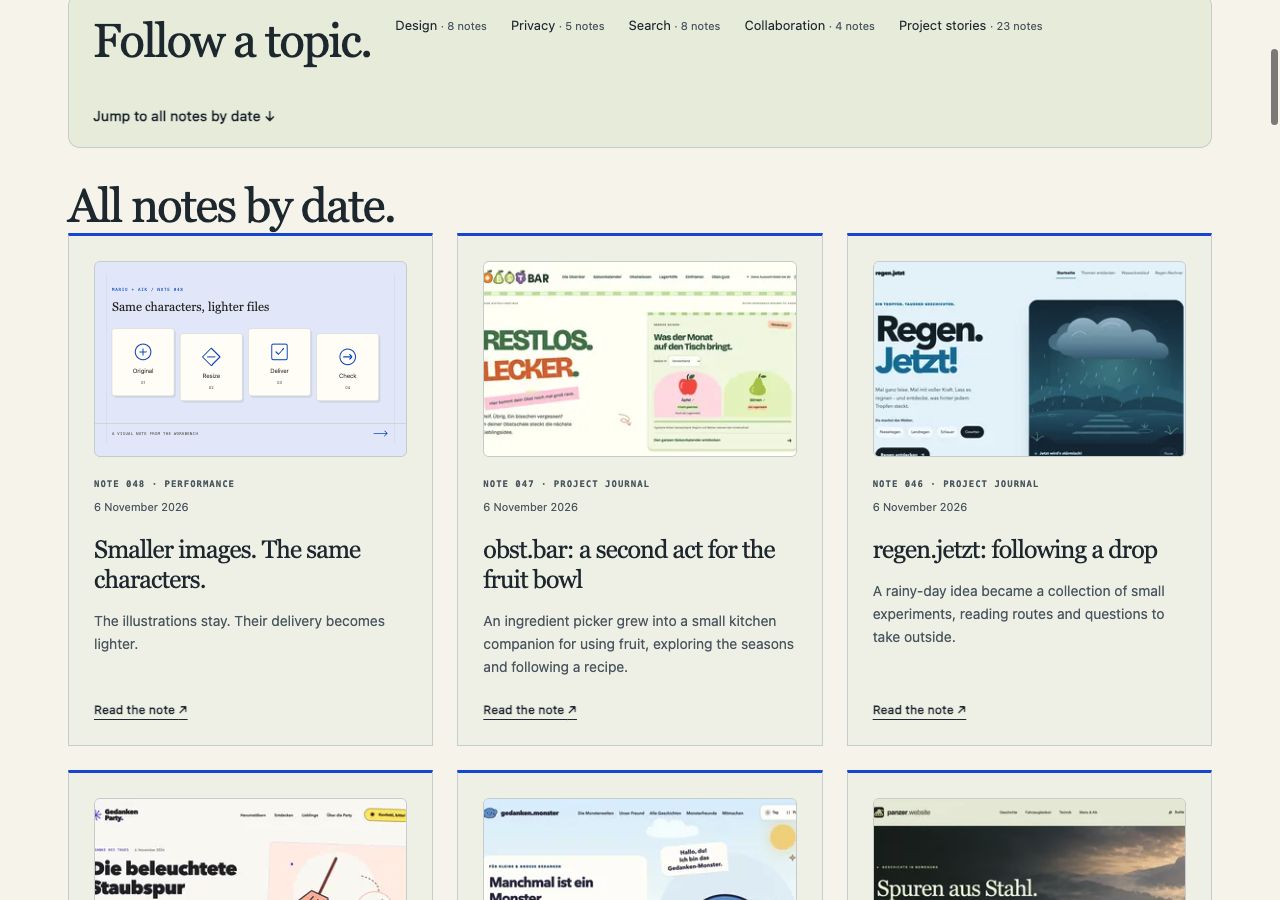
The journal already scored 100 in both profiles but downloaded unnecessarily large card images. We created 360- and 720-pixel previews for 25 raster images. Together, the 360-pixel files are about 95.5 percent smaller than their originals. This compares file sizes, not the measured savings of every visit. SVG diagrams remain SVG, and full original images remain available in the notes.
The final follow-up measurements of the day
Performance scores and LCP (Largest Contentful Paint: when the largest visible content element appears). Rows come from each page’s final post-deployment check, not one simultaneous test of everything.
| Page | Mobile | Desktop | LCP mobile / desktop |
|---|---|---|---|
| FYI EN | 100 | 100 | 0.90 / 0.40 s |
| FYI DE | 100 | 100 | 0.90 / 0.45 s |
| Lab / | 100 | 100 | 0.78 / 0.44 s |
| Lab /projects/ | 100 | 100 | 0.79 / 0.28 s |
| Lab /notes/ | 100 | 100 | 1.05 / 0.28 s |
All final checks listed here also scored 100 for Accessibility, Best Practices and SEO, with Total Blocking Time of 0 ms and Cumulative Layout Shift of 0. The project directory’s desktop LCP improved from 1.57 to 0.28 seconds, and the journal’s from 0.37 to 0.28 seconds.
More than a score
We checked the three homepages at 320 and 390 CSS pixels and the workshop at wider desktop sizes. No horizontal page overflow appeared. Note 047’s image previews stayed inside the text column in both languages, with originals accessible. After the changes, we checked the affected scenes, project illustration and journal cards again.
Checks covered skip links, visible keyboard focus, German main navigation, scene selection in both FYI languages and the expandable note archive. In the Lab, pressing Space activated “Pause Aik” and paused the animation. This was not a complete screen-reader or WCAG conformance audit.
The link check opened 160 distinct HTTP(S) destinations from the three homepages, including collapsed note links: 125 on our two websites and 35 external destinations. Associated nonempty fragment anchors were checked. No visible error page or missing checked anchor remained. This was a browser content check, not an HTTP status-code crawl or a recursive review of every page. Redirects from obst.casa and wanderlust.wiki to /de/ were expected behaviour.
What 100 points cannot promise
The reports used Lighthouse 13.6.0, an emulated Moto G Power with slow 4G on mobile and the desktop lab profile. Real-user data was unavailable. Follow-ups are individual lab observations; repeated requests can reuse results. The integrated browser did not run a separate throttled-network test or timing trace. A score of 100 guarantees neither every visitor’s experience nor complete accessibility, privacy compliance or search rankings.
The practical lesson: even a 100-point page can transfer unnecessary image data. Suitable image sizes and reserved space matter beyond the score. The earlier 3 November measurement remains in field note 046; Zettelwirtschaft 048 also documents the Lab changes.
