
A big question, an everyday voice
On 11 October 2026, Mario asked for a website about how plants came to be and how they changed through Earth’s history. The brief combined scientific sources with everyday language, explanations of unfamiliar terms, generated illustrations and diagrams. Pflanzen.website is available in German only.
A timeline with room to wander
The first design introduced a movable timeline and twelve stations. Mario then asked for shorter, connected pages rather than one increasingly long scroll. The project grew into a discovery atlas linking Earth history, plant relationships, forests, soils, fossils and clearly labelled future scenarios.
From reading to trying
Small laboratories give readers a way to explore processes: follow germination, trace water through a plant or move from a flower to a fruit. Later additions include a photosynthesis model, a tree through the seasons and a closer look inside a leaf. These are simplified learning models, with explanations of what they leave out.
Take the question outside
The November additions connect the screen with observation. A seed-travel laboratory compares transport by wind, animals and water; a plant comparison highlights different features. One Square Metre of Nature invites readers to look closely outdoors and distinguish what they observe from what they infer.
Pictures, sources and responsibility
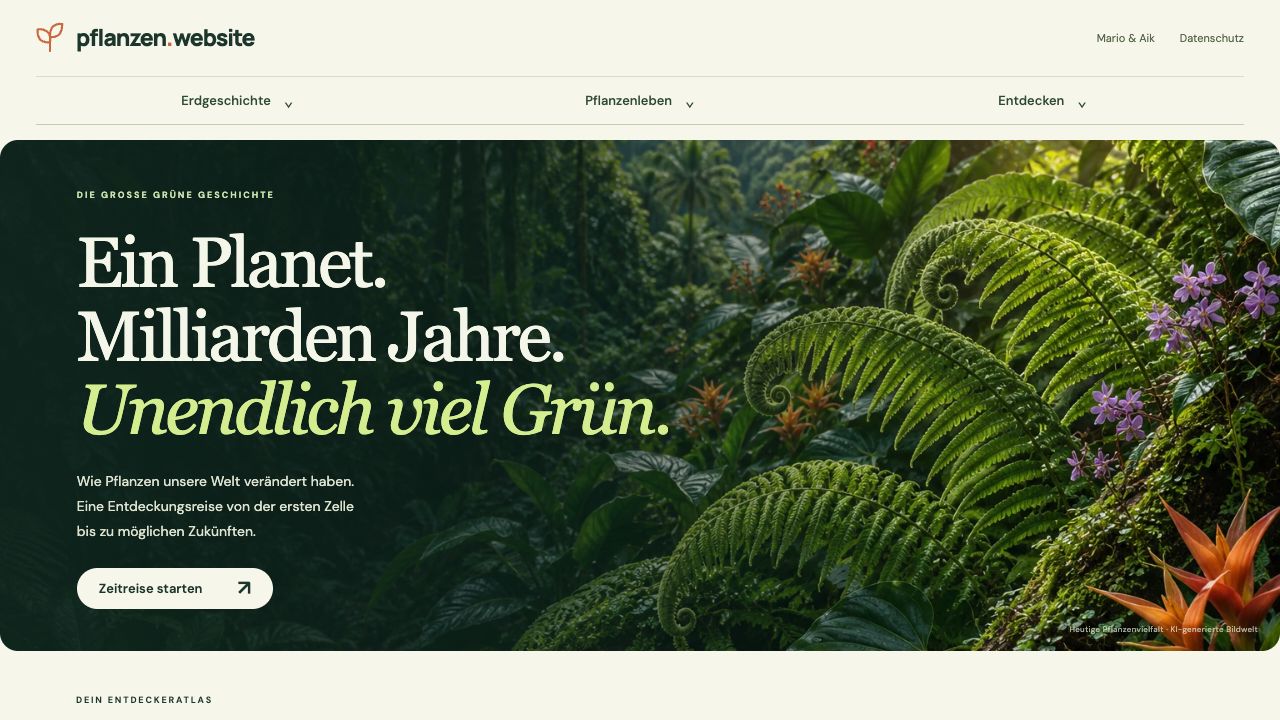
The atmospheric plant worlds are labelled as AI-generated imagery. Diagrams explain selected relationships; illustrations are not historical photographs or proof of a scientific claim. Mario sets the direction, reviews the work and retains editorial responsibility. Aik is his AI assistant, helping with research, writing, imagery, design and code.
Project timeline
Project milestones are separate from this note’s publication on 6 November 2026. Dates follow the project records and Europe/Berlin calendar.
Project brief
Mario requested a scientifically grounded, colourful journey through plant history in everyday German. This is the earliest dated project brief found.
First implementation
A private prototype introduced a twelve-station timeline, illustrations and interactive explanations. Work then continued locally, expanding into shorter connected pages.
Public domain launch
The website was published at pflanzen.website. This public launch is distinct from the private prototype of the previous day.
Four nature laboratories
The meadow, germination, water-journey and flower-to-fruit laboratories were published.
More ways to explore
Photosynthesis, seasons, leaf views and discovery paths went live, followed by seed travel, plant comparisons, outdoor observation and short term explanations.
Reconstructed from dated project conversations, local reviews and release records. Earlier ideas are dated only where documented.
