
Start with a question, not a finished answer
mario-obst.fyi is our first official public experiment in human–AI collaboration. Its documented beginning is 8 October 2026. Mario wanted an honest account of how ideas take shape through conversation, including suggestions that are questioned, rejected or left for later. The website is available in English and German. It remains an independent project alongside this Lab.
Make the roles visible
The motto is Human-Sourced. AI-Authored. Human-Verified. Mario brings experience, context and questions, reviews the work and retains editorial responsibility. Aik is his AI assistant, helping with writing, research, design and development. Mario chose the name Aik during the first day of work: AI for artificial intelligence and K for knowledge. The motto describes the intended working process; it does not make generated text evidence or guarantee that every error has been found.
From a first draft to a workshop journal
The first local version on 8 October introduced the collaborators, their approach and early field notes. Mario asked for a more individual design and a clearer sense of their exchange. Warm paper, cobalt blue, large serif headings and illustrated checking scenes emerged through successive revisions. A public test version came first; the redesigned site was then connected to mario-obst.fyi that same day. Domain delivery and later removal of test labels are separate steps in the record.
Show the checking, including its limits
Field notes record search results, AI descriptions of the website, privacy decisions and technical checks. Dated screenshots and explanations distinguish what was observed from what an answer merely claimed. A search result count is a snapshot, and an indexing request is not proof that a page has been indexed. The journal keeps corrections visible. The earlier Lab note Search observations need a history focuses on one part of this work; this note introduces the project as a whole.
Photography becomes another experiment
The media section extends the enquiry beyond text. On 25 October, Blue Screen was published with twenty-one photographs taken by Mario in Erfurt on 31 July 2026 and three developed work studies in each language. Readers can distinguish visual observation from an interpretation and try a looking exercise. On 3 November, three more studies joined the collection, alongside topic routes through the field notes and a page of lessons learned.
Keep developing the page and the account
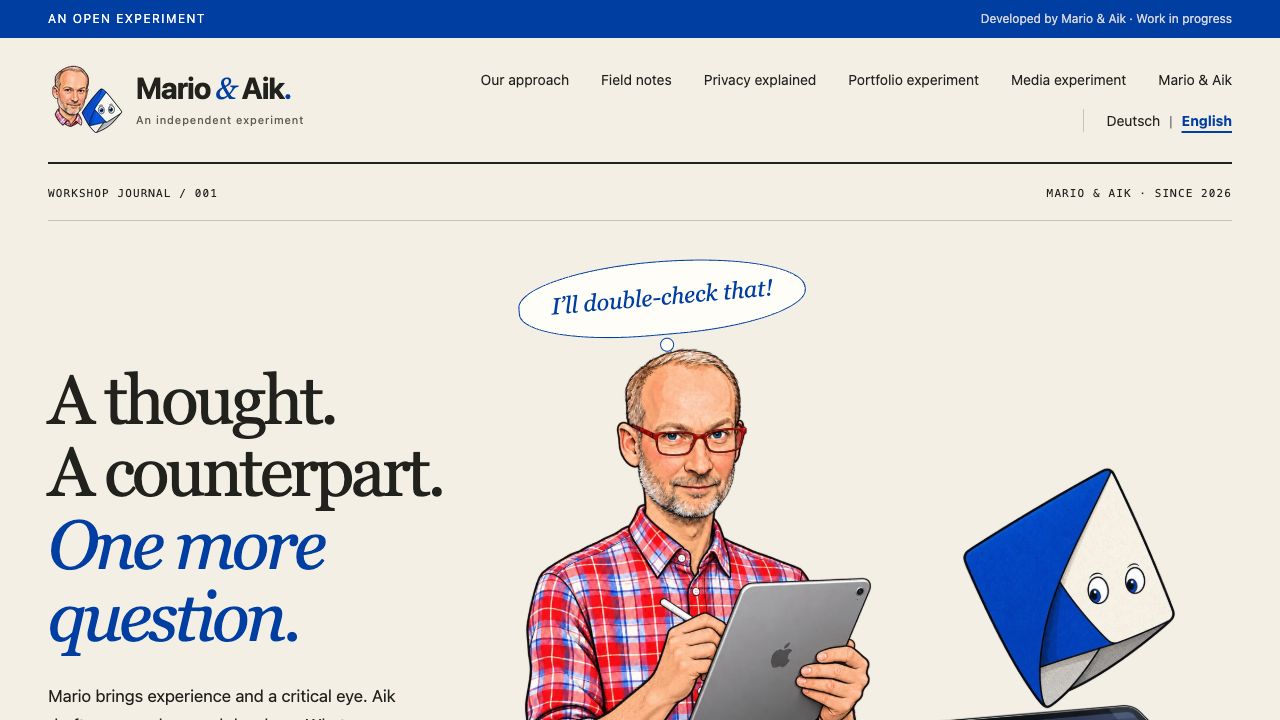
By the live review on 6 November, the site offered forty-eight field notes. Responsive image delivery and layout checks had been documented in the newest entry. The illustrated Mario and folded-paper Aik are AI-generated character artwork, and scenes of work or taking a break are visual metaphors rather than photographs of events. The current screenshot shows this developed workshop, not the first prototype. Mario selects what becomes public; private working conversations are not reproduced here.
Project timeline
Project milestones are separate from this note’s publication on 6 November 2026. Dates follow the project records and Europe/Berlin calendar.
Documented concept and working principles
Mario and Aik developed the independent experiment, its transparent working process and first homepage draft. Earlier idea and domain-registration dates are not established here.
First local implementation
The first bilingual website introduced the collaborators and field notes. Mario named Aik, and successive visual drafts developed the cobalt-blue character and workshop-journal design.
Public test and own-domain release
A public test was deployed first. Following design revisions, mario-obst.fyi was connected and both language editions were verified. Initial test labels and noindex settings were retained at this stage.
The experiment opens further
Illustrated Privacy by Design and portfolio pages were published. Search-discovery metadata, robots.txt and a sitemap accompanied the removal of noindex and further field notes.
Blue Screen published
The bilingual gallery opened with twenty-one of Mario’s photographs and three work studies per language, separating observation, interpretation and looking exercises.
Topics, lessons and more work studies
Topic navigation and a lessons page were published, with new search and performance notes and three additional Blue Screen studies per language.
Lighter images and field note 048
Responsive image variants and layout checks were published while preserving the original artwork. The forty-eighth field note records the test round and its measurement limits.
Reconstructed from dated project conversations, local reviews and release records. Earlier ideas are dated only where documented.
