
A question, then a website
Correction added 6 November 2026: this note originally placed the project’s beginning on 24 October. The preserved development and release records establish a working implementation and public launch by 22 October 2026. The starting point is curiosity about our cosmic neighbours: how worlds form, how they change and how we learn about places we cannot simply visit. This note records that beginning on 29 October, as the project continues to grow.
Follow a world, or follow a question
The German-language learning project introduces all eight planets and connects their histories with the Sun, moons, space exploration and the origins of our Solar System. Visitors can choose a planet, follow a guided discovery journey, look up a term or explore questions that lead further out into astronomy.
Try an idea for yourself
Interactive learning models invite visitors to compare worlds, explore gravity and watch simplified planetary motion. The homepage pairs a moving Solar System with an eclipse laboratory: changing the geometry helps explain why an eclipse does not happen at every new or full Moon. Other routes lead to the life of stars, the Milky Way and the elements from which worlds are made.
Models need their boundaries
An inviting model must also explain what it leaves out. The homepage labels its orbital view as schematic: sizes and distances are not to scale, the orbits are simplified circles and the display does not show current planetary positions. Its eclipse experiment explains geometry rather than predicting dates. Sources, a model-limits guide and a sources-and-maintenance page help visitors put what they see in context.
One human, one AI assistant
Mario directs the project, reviews the work and retains editorial responsibility. Aik is his AI assistant, helping with research, writing, design and code. This is a private learning project that can develop through questions and corrections; AI assistance is not a substitute for independent specialist review.
Two doors into the same workbench
Visit planeten.website to explore the project. Its homepage already links back to Mario & Aik Space through the “Neugier verbindet” section. This journal offers the view from our workbench; the learning website lets the questions themselves lead the way.
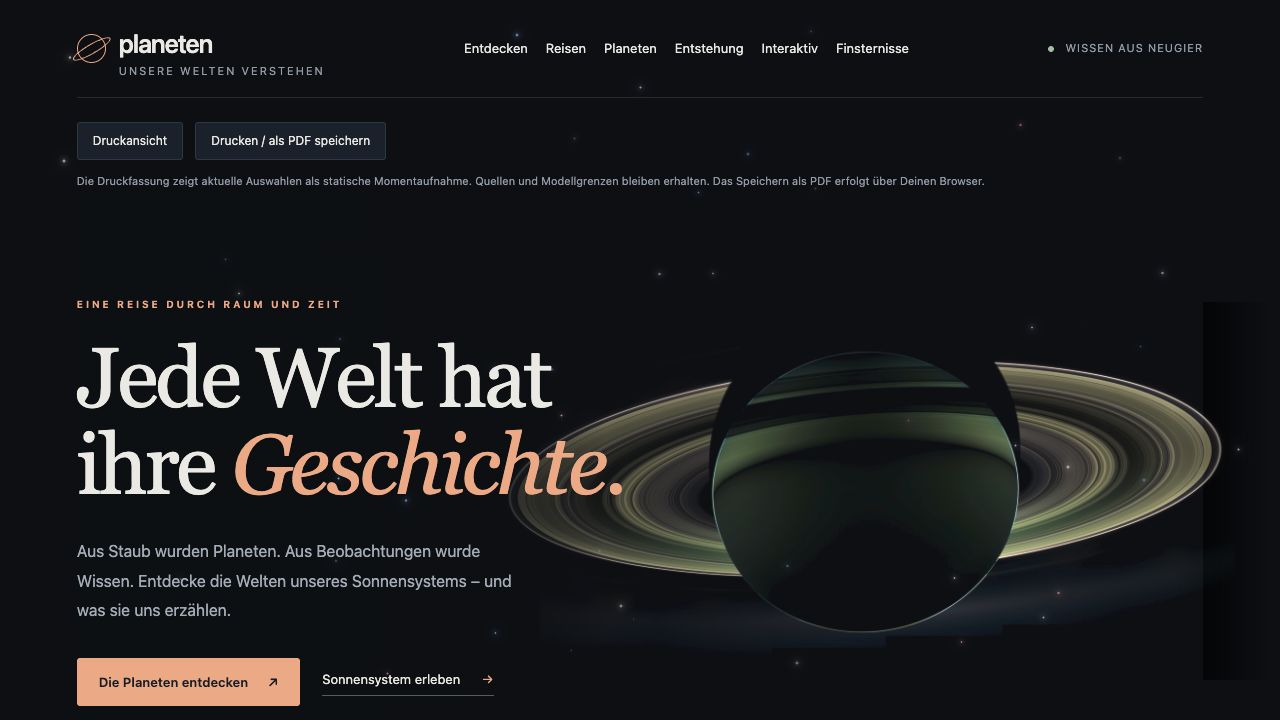
A view of the homepage
At Mario’s request, we added a locally served screenshot of the project homepage to this note. External web links throughout the lab now open in a new tab, including the screenshot and project button. The screenshot is a dated view of the website, not a live embedded page.
What this note establishes
The original start date came from Mario; the timeline added on 6 November corrects it using the dated project release records. The descriptions above reflect a review of the public homepage on 29 October 2026, not a full scientific, accessibility or privacy audit. The note adds a project link and a development record; it makes no change to search-indexing settings.
Project timeline
Project milestones are separate from this note’s publication on 29 October 2026. Dates follow the project records and Europe/Berlin calendar.
Timeline added 6 November 2026 from the preserved project records.
Earliest documented implementation
The preserved launch records describe a working local homepage, Mercury page, Solar System view, eclipse laboratory and time comparison. The exact earlier idea date is not established.
First public release
The main domain and five initial content pages were publicly verified. The dated launch records establish this release two days before the start date previously given in this Lab note.
Beyond the first planet
Successive releases added the other planets, the Moon, Sun, dwarf planets and further Solar System topics, with explanatory models and sources.
Stars, galaxies and learning routes
The collection expanded through stellar and galactic topics, discovery journeys and a shared topic-and-glossary search. Printable reading pages and shareable laboratory settings followed.
More ways to explore for yourself
Four learning pages on cosmic scale, misconceptions, the night sky and cosmic history were published. Laboratory instructions and a tenth discovery journey accompanied the expansion.
Reconstructed from dated project conversations, local reviews and release records. Earlier ideas are dated only where documented.
